

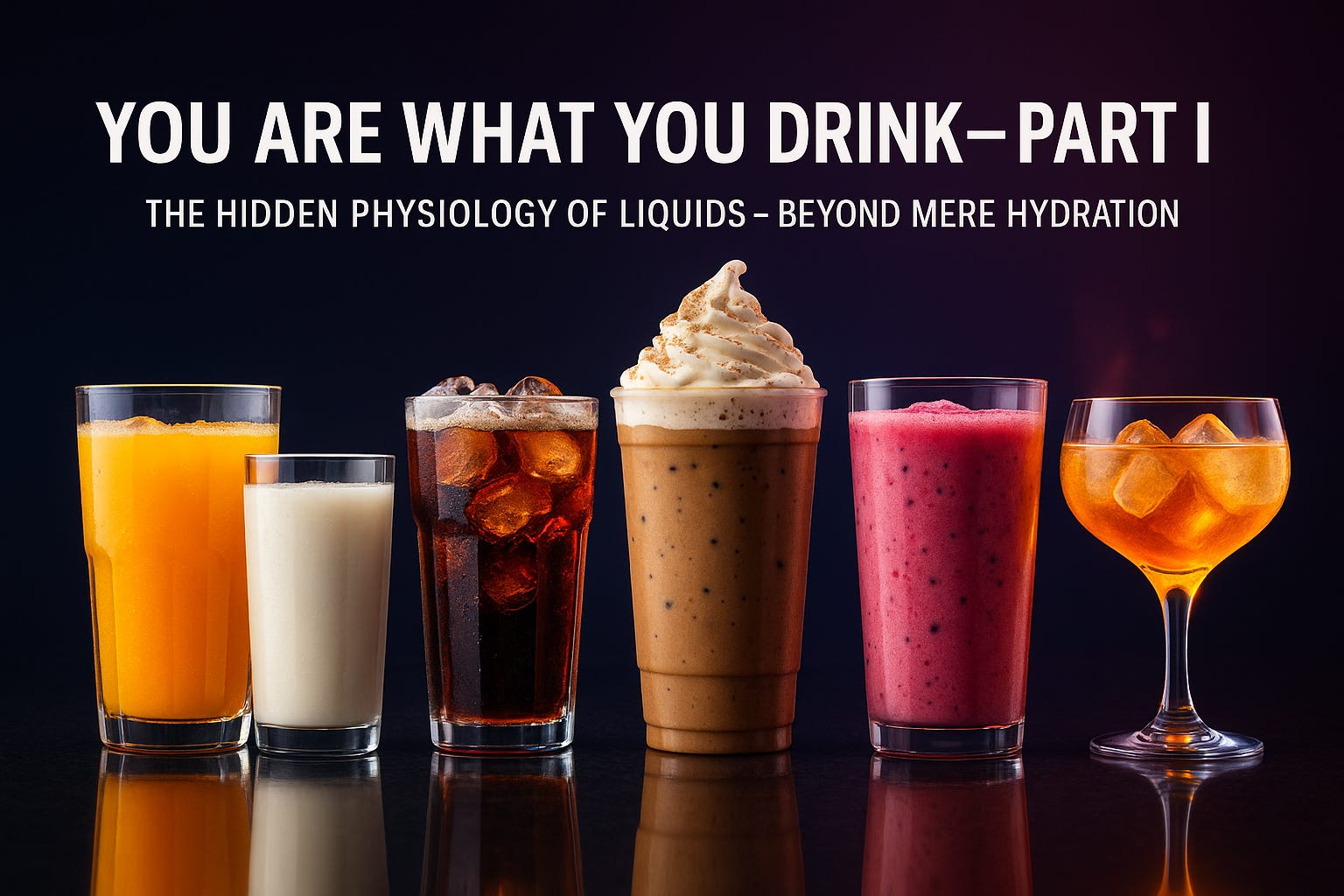
You Are What You Drink — Part I
The Hidden Physiology of Liquids - Beyond Mere Hydration
Signal Capture
We’ve all heard it: You are what you eat.
But that’s only half the story — and maybe not even the most important half.
What you drink determines how your body interprets what you eat.
Liquids set the hormonal climate where food is burned or stored, focus is sharpened or blurred, and energy either flows or stalls.
Every sip — water, coffee, soda, juice, milk, or alcohol — shapes your internal environment. Each one either supports the body’s design or quietly works against it.
We’ve optimized macros, meal timing, and sleep cycles.
But the frontier most people miss is liquid discipline — understanding how what you sip writes biochemical instructions to every organ system.
Because you aren’t just what you eat. You are what you drink.
Design, Not Accident
The human body isn’t random machinery; it’s deliberate architecture — a living ecosystem tuned for feedback and balance.
Liquids are the medium that keeps that ecosystem communicating. When hydration, hormones, and timing align, the system runs as intended: alert, efficient, and calm.
This isn’t evolution by accident.
The same Designer who wired the brain to think also wired the bloodstream to cleanse it, the kidneys to purify it, and the liver to regulate it.
Every drop of water you drink honors that design — a quiet partnership with the way you were made.
Core Protocols: Why Water Rules Metabolism
1️⃣ Cognitive Performance
Your brain is about three-quarters water.
A drop of just 1–2 percent dehydration slows reaction time, clouds memory, and elevates cortisol — making every task feel heavier than it is.
Water isn’t just hydration; it’s the conductor’s baton for thought.
Each night while you sleep, the glymphatic system flushes waste from your brain — neurons shrink, cerebrospinal fluid flows, and toxins like beta-amyloid are washed away.
That cleansing depends on hydration.
Without enough water, that rinse cycle slows. You wake foggy, irritable, or inexplicably low — not because you slept poorly, but because your brain never got cleaned.
Hydrate not just for energy, but for restoration.
A hydrated brain is sharper, steadier, and more resilient. Clarity itself is a biological state.
2️⃣ Metabolic Efficiency
Water is the unsung hero of fat loss.
Breaking down fat (lipolysis) requires it.
Thermogenesis — your calorie burn — rises after a single glass.
Every detox and digestive process depends on it.
Your kidneys need water to filter blood. When they don’t get enough, the liver picks up the slack — and that’s a problem, because the liver’s real job is hormone balance and fat metabolism.
When it’s busy doing janitorial work, fat burning stalls.
Even mild dehydration thickens the blood, forcing the heart to work harder and slowing oxygen delivery.
The body literally becomes less efficient — a well-designed engine running on sludge.
That’s why chronic dehydration masquerades as “slow metabolism.”
Hydration restores the division of labor: kidneys filter, liver burns, hormones balance. It’s the quiet cooperation of design.
3️⃣ Mood and Motivation
Hydration drives neurotransmitters.
Low water means low dopamine and serotonin — the same molecules that regulate drive and satisfaction.
Hydrated people report higher optimism and steadier moods; dehydrated people report fatigue and irritability.
Dehydration doesn’t just dry your mouth. It dries your will.
The Line Between Design and Distortion
As we can see, water isn’t just important — it’s essential. It’s the foundation of every metabolic rhythm, every neural spark, every chemical conversation in the body. You can live weeks without food, but only days without water.
We are, by design, a beautifully tuned biochemical ballet. Every organ, enzyme, and neuron moves in coordination — and the entire performance begins with water. It’s the first note of the song, the opening line of the code.
Get hydration right, and every system harmonizes — energy flows, hormones balance, focus sharpens. Get it wrong, and even the best nutrition, training, or sleep can’t compensate.
In Part II, we’ll unpack the how: when to drink, how much, how electrolytes amplify performance, and which beverages actually cooperate with your biology instead of confusing it.
But before we build the right inputs, we need to understand the wrong ones — the distortions that quietly reprogram your metabolism.
Because the next chapter of this story isn’t about thirst. It’s about temptation.
Sweet Signals and Insulin Timing
Sweetness is never neutral.
The moment your tongue tastes something sweet, your brain signals the pancreas to prepare insulin for the sugar it expects to arrive.
If no sugar shows up, insulin still drops blood glucose — leaving you hungrier and crankier than before.
That anticipatory response is designed for survival — a built-in warning system meant to help us process the rare sweetness nature once offered.
But in a world of constant artificial sweetness, it’s like revving the engine all day while stuck in park.
That’s why “zero-sugar” drinks often sabotage fasting and focus.
The body doesn’t count calories; it reads chemistry.
Keep mornings neutral: water, black coffee, or electrolytes.
Let your system wake up clean before introducing sweetness.
It’s not punishment. It’s giving your metabolism a quiet space to work.
Metabolic Saboteurs — When Drinks Turn Against You
We live in a culture drinking itself sick — not just with alcohol, but with invisible calories and chemical confusion.
Our ancestors drank water, milk, wine, and tea.
Today’s beverages are engineered for addiction — perfectly balanced combinations of sweetness, caffeine, and flavor chemistry designed to hijack reward circuits.
They’re liquid marketing, not nourishment — profit over physiology.
The problem isn’t quantity; it’s misalignment.
We drink the wrong things, at the wrong times, for the wrong reasons.
Some drinks work with your biology. Others quietly rewrite it.
Here’s how to tell the difference.
1️⃣ Juices — The Fructose Trap
Juice wears a health halo but behaves like liquid sugar.
Fructose must be processed by the liver before it becomes usable energy.
That detour steals bandwidth from detox and hormone regulation.
Over time, excess fructose contributes to fatty liver and insulin resistance — slow, silent suffocation of metabolism.
In nature, the poison comes packaged with the cure.
Eat the apple, get the fiber.
Drink the juice and you’re just mainlining fructose.
2️⃣ Milk and Milk Alternatives
Milk is food, not hydration.
Lactose is sugar. Casein spikes insulin.
Most substitutes aren’t much better:
Oat milk → liquid starch
Almond milk → nutrient-thin filler
Soy milk → hormonal wildcard
Whole milk → nourishing, but for meals only
If it’s built to grow a calf, it’s not built for your fast.
3️⃣ Sodas — The Industrial Sugar War
In the 1970s, U.S. farm policy began subsidizing corn. Chemists turned the surplus into high-fructose corn syrup, cheaper than cane sugar.
By the 1980s, HFCS had replaced sugar in nearly every soda and processed food.
The result: a nation swimming in subsidized sweetness — and within a decade, obesity, diabetes, and fatty-liver rates exploded.
Fructose bypasses your fullness signaling.
It doesn’t trigger leptin (the stop-eating hormone) or suppress ghrelin (the hunger one).
It heads straight to the liver, where it’s metabolized like alcohol — creating fat and dependency.
Diet soda isn’t the fix.
As Dr. Jason Fung notes, even artificial sweeteners trigger cephalic-phase insulin release — your brain tells the pancreas sugar is coming.
You drink fewer calories but still create metabolic confusion.
Meanwhile, aspartame and sucralose can disrupt gut bacteria and increase appetite.
Context matters: if you’re fasting, sweetness breaks the spell.
If you’re eating, it’s less harmful — but it’s still not hydration.
No one ever got rich off credit-card points, and no one ever got fit off diet soda.
If you’re going to drink soda:
Occasional: a real-sugar soda with a meal.
Avoid entirely: HFCS-based colas — nearly every restaurant fountain drink.
What began as farm support became a pipeline of sugar into every lunchbox and vending machine.
It wasn’t conspiracy — just poor economics with dire metabolic consequences.
4️⃣ Dessert Drinks — Milkshakes with Marketing
Frappuccinos, bubble teas, and slushes aren’t beverages; they’re desserts.
Sugar, cream, and syrup dressed up as lifestyle choices. They belong in the treat category, not the daily rotation.
Even the “healthy” option — the smoothie — can pack multiple servings of fruit, yogurt, and honey, turning into a sugar bomb wearing gym clothes.
Not all smoothies are created equal. There’s fruit, and there’s fruit macerated in scoops of sugar.
Check the ingredients or make your own. Some shops do it right:
whole fruit, no syrup blends, clean protein, balanced macros.
Smart choices:
Water or unsweetened almond milk base.
Whole fruit, spinach, or kale over purees.
Add protein (whey, pea, or collagen).
Add healthy fats (chia, flax, nut butter).
Even made smartly, smoothies are meals, not snacks.
Take them within your eating window — not during a fast.
Whole-fruit versions made at home are a different story: fiber and sugar together are allies.
Fiber slows absorption, balances hormones, and feeds gut bacteria.
Just remember — fiber needs water to work.
5️⃣ Alcohol — The Metabolic Double Agent
Alcohol is, biologically, a toxin — a moderately fun toxin, but a toxin nonetheless.
The moment it enters your bloodstream, the liver drops everything to neutralize it.
Fat burning, hormone regulation, and detox all pause until the intruder’s gone.
Add sugar — beer, wine, cocktails — and you’ve blocked both glucose and fat metabolism.
Sleep fragments, recovery stalls, cortisol spikes.
Drink responsibly, with food, and never as anesthesia.
If you need it nightly to unwind, it’s no longer a drink. It’s a leash.
6️⃣ Energy Drinks — Borrowed Energy, Real Debt
Energy drinks don’t give energy; they loan it.
Caffeine, taurine, and sugar flood dopamine and cortisol pathways — alertness now, exhaustion later.
If you truly need one, choose transparency: natural caffeine, minimal ingredients, no synthetic sweeteners.
But don’t build your routine on them. The real fix isn’t in a can — it’s in sleep, sunlight, hydration, and discipline.
They’re an emergency tool, not a lifestyle. Borrow energy too often, and you’ll pay it back with interest.
⚡ Final Transmission
Every drink is a decision. A signal sent to your biology that says build or break down, focus or fog, restore or decay.
We live in an age of abundance but suffer from malnourishment — not because we lack calories, but because we’ve replaced nourishment with stimulation. A steady drip of sweetness, caffeine, and chemical reward keeps the body confused and the mind craving more.
An occasional indulgence isn’t the problem. The problem is the drift — the slow, unexamined slide into habits that work against our design. A milkshake once a week won’t derail you. But a diet of daily dessert disguised as coffee will.
These are adult choices. And adults understand that choices compound — biochemically, mentally, spiritually. You can’t hack physiology. You can only cooperate with it or fight it.
When you see your drink not as a treat but as a message to your cells, everything changes. Each sip either honors the design or defies it. And the body always answers truthfully.
⤵️ Next in Part II: The Strategy
You’ve seen the physiology: water restores, sweetness distorts, and timing determines what gets burned or stored.
Now comes the part that changes your day — how to run the system on purpose.
In Part II, we’ll deploy the stacks and rituals: the metabolic tonic, the pre-meal fiber play, coffee done right, tea as precision fuel, and the morning launch sequence that turns the Dawn Effect into momentum.
If Part I showed you the code, Part II teaches you to write it.
Read Part II Here.
[FIN/ACK]
Transmission Complete
Process Accordingly
— Protocol One

If you value the work that goes into these deep-dive studies — the research, the writing, the design — consider fueling the mission.
Every coffee supports independent research, better visuals, and more content that cuts through noise and gets to truth.