

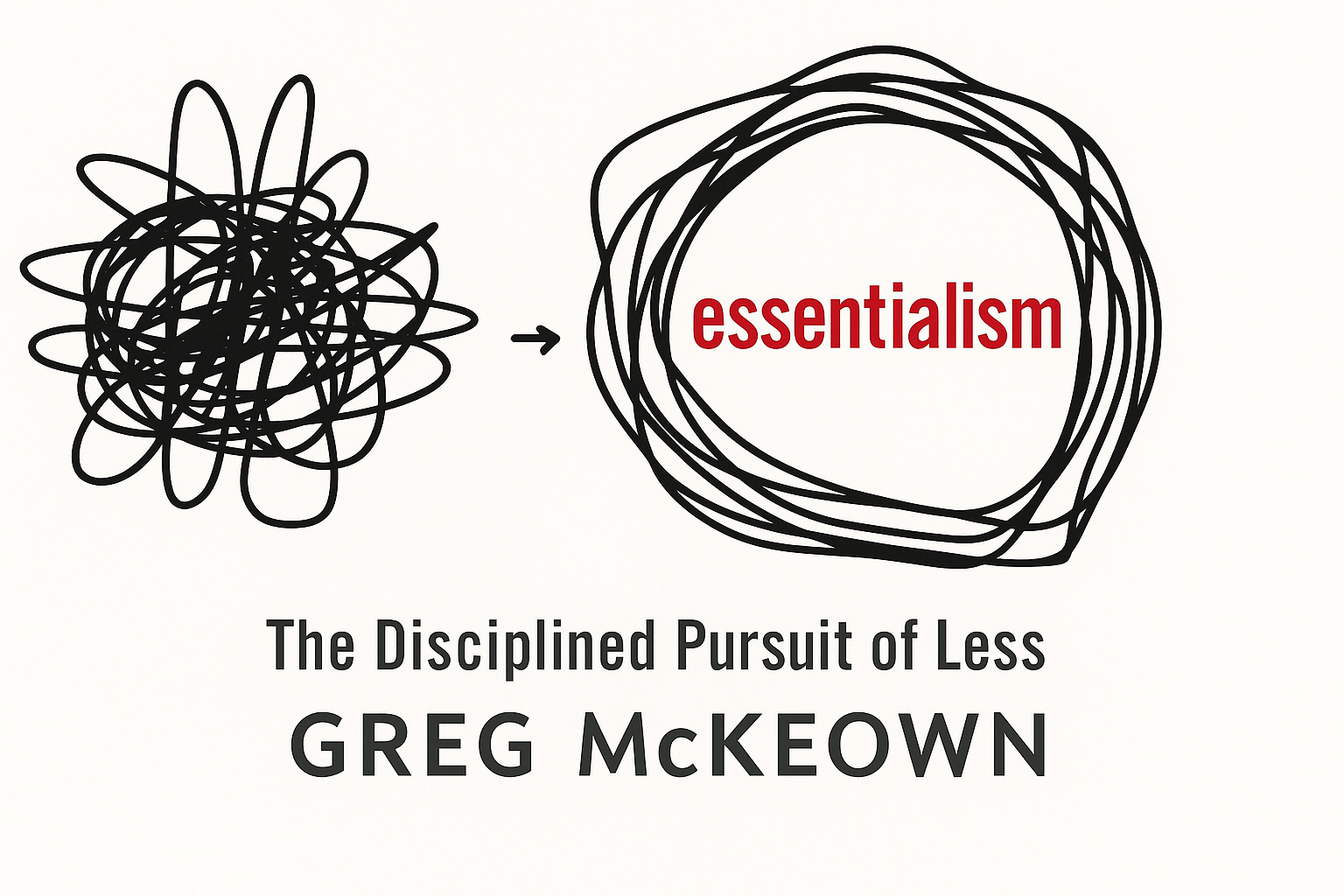
Book Review: Essentialism by Greg McKeown
The Counterintuitive Power of Doing Less So You Can Do What Matters Most
SIGNAL CAPTURE
You are exhausted—not because you’re lazy or undisciplined, but because your attention is constantly under pressure. Every text message. Every meeting invite. Every group chat, news alert, and last-minute ask. They all pull at you, fragmenting your focus and hijacking your peace.
And the real cost isn’t just time. It’s misalignment.
You are being pulled in every direction except the ones that count. Not just in your schedule, but in your purpose. The urgent is crowding out the important. The noise is drowning out the quiet voice that already knows what really matters.
You feel overworked but underutilized because most of what you’re spending your time on isn’t essential. It’s just what showed up.
So let me ask you directly:
When was the last time you paused—not to catch up, but to reset? When did you last ask, Is this the life I was meant to live... or just the one I drifted into?
Essentialism is not about getting more done. It’s about getting the right things done. Not productivity for productivity’s sake—but a practical framework to protect what truly matters and reclaim the path you were made for.
McKeown isn’t offering a to-do list. He’s offering a reset. A chance to stop reacting, start discerning, and build a life on fewer, better things.
This isn’t about efficiency. It’s about integrity.
You cannot do everything. But you can do what matters.
Start there.
CORE PROTOCOLS
Prioritize the Essential
McKeown challenges the illusion that everything matters equally. Essentialism is the disciplined pursuit of less—but better. That means identifying your highest point of contribution and clearing the space to operate there.
If you’re not sure what your highest point of contribution is, that’s your first task. Begin with reflection, not reaction.
McKeown quotes poet Lin Yutang: “The wisdom of life consists in the elimination of non-essentials.” This is not about neglect—it’s about narrowing your focus so you can give your best where it counts most.
Even Jesus modeled this. In Mark 1:35, He rose early to pray and then walked away from the crowds, saying, “Let us go somewhere else... so I can preach there also. That is why I have come.” Purpose clarified. Distraction denied.
Say “No” More Often
Saying no is not rude. It’s responsible. If you don’t set boundaries, others will do it for you.
McKeown offers simple scripts like, “I’d love to help, but I’m fully committed right now.” Short, clear, and respectful.
Most of us say yes not because we believe in the opportunity, but because we fear discomfort. Essentialists learn that saying no is not a rejection—it’s stewardship. Stewardship of time, energy, and mission.
Simplicity Is a Force Multiplier
Complexity is seductive, but it’s also corrosive. Whether it’s an overstuffed calendar or an overcommitted brain, complexity drains clarity. Essentialists cut through the noise to regain precision.
Think of Proverbs 4:25: “Let your eyes look straight ahead; fix your gaze directly before you.” Focus is moral, not just mental.
Rest Is a Prerequisite, Not a Perk
High performance requires strategic recovery. Rest isn’t a luxury—it’s part of the design.
McKeown reminds us: sleep, reflection, and stillness aren’t indulgences. They’re fuel. When we rest well, we think clearly. When we don’t, we lose both perspective and performance.
Even God rested. Not because He needed to, but because He was modeling the rhythm of life. Sabbath isn’t weakness. It’s alignment.
Trade-Offs Are Strategic
You can do anything, but not everything. Essentialists understand that trade-offs are not unfortunate—they are fundamental.
Every yes is a no in disguise. The question is: are you trading for something worthy?
McKeown urges us to pursue the “essential few” over the “trivial many.” Choosing the better yes is how you protect the mission.
Clarity Over Ambiguity
Essentialists pursue clarity—not in the sense of controlling outcomes, but in identifying what truly matters. If you don’t know why something’s important, it will never hold priority when the pressure hits.
Clear purpose enables clean decisions. And when decisions are clear, stress diminishes.
Small Wins, Big Impact
You don’t have to overhaul your entire life. Start small. Clean out one drawer that stresses you out. Reclaim one 15-minute block in your schedule. Say one assertive no to a non-essential commitment.
McKeown emphasizes progress through momentum. Tiny, focused decisions are how systems change. One aligned action at a time.

CORTEX OPS
The principles in Essentialism aren’t just philosophical—they’re backed by cognitive science. In fact, they map almost perfectly to the way your brain is designed to function under pressure.
Let’s start with the prefrontal cortex. This is the executive command center of the brain—responsible for planning, focus, decision-making, and self-control. When you’re constantly juggling tasks or bombarded by interruptions, this region becomes overwhelmed. You shift from strategic thinking to reactive mode.
That’s not just mental clutter. It’s neurological drift.
Multitasking? It’s a myth. What we call multitasking is really task-switching, and every switch comes with a cost. Research from Stanford shows that frequent context-switching can reduce attention span, lower working memory, and increase error rates. Essentialists defend their attention like it’s bandwidth—because biologically, it is.
Now consider rest. When you sleep, daydream, or enter solitude, your brain activates the Default Mode Network (DMN). This isn’t downtime—it’s deep time. The DMN helps integrate information, form insights, and consolidate long-term memory. It’s your mind’s backstage crew. Neglect it, and creativity stalls. Nurture it, and clarity emerges.
Even the simple act of saying no has neurological weight. Repeatedly asserting boundaries strengthens the medial prefrontal cortex—linked to identity formation and value-based decision-making. In other words, saying no literally wires your brain for stronger self-awareness.
This is why Essentialism isn’t just time management. It’s cognitive alignment. It’s neurological integrity.
You’re not optimizing a to-do list. You’re training your brain to serve your calling.
TACTICAL DEPLOYMENT
Now that we’ve identified why essentialism matters, let’s get tactical. These are field-ready strategies—not theories—but practices that help you create space for what truly counts.
Conduct a Life Audit
List every commitment, responsibility, and recurring obligation. Then ask: If I weren’t already doing this, would I choose it now? Most people live reactively. This audit turns your calendar into a mission filter.Script Your “No”
Saying no on the spot is hard—especially under social pressure. Prepare language in advance: “That sounds great, but I’m focused on fewer things right now.” Or: “I’m fully committed at the moment, but I appreciate you asking.” Polite. Clear. Final.Protect Priority Time
Don’t wait for free space to magically appear in your day. Create it. Protect it. Whether it’s writing, prayer, study, or planning—it only happens when you block time and treat it like a non-cancelable meeting with your future self.Declutter Physical and Digital Space
Your environment shapes your attention. Clean your desk. Silence your notifications. Remove one app that doesn’t serve you. Mental clarity often starts with visible order.Prioritize Sleep and Recovery
According to the CDC, 1 in 3 adults doesn’t get enough sleep—yet sleep deprivation impairs focus as much as alcohol. Recovery is not laziness. It’s preloaded capacity for tomorrow’s clarity.Build a Quarterly Reset
Once a quarter, pause. Step back. Ask: What am I doing that no longer aligns with who I’m becoming? Cancel what no longer fits. Recommit to what does. Your calendar should evolve with your clarity.Design a Decision Filter
Create a personal rubric for saying yes: Does this align with my values? Will this create momentum, or just motion? If it’s not a clear yes—it’s a gentle no. The filter does the work, so you don’t have to wrestle every time.
CRITIQUE NODE
The essentialist mindset is powerful—but it isn’t magic. You may not have full control over your schedule. You might be raising kids, managing crisis-mode logistics at work, or navigating a season where obligations outweigh options. Life doesn’t always yield to clean minimalism or white space on the calendar.
But that doesn’t mean Essentialism is out of reach.
McKeown never promises a frictionless life. What he offers is permission—permission to pause, to choose, and to protect what matters, even when complexity won’t go away. Essentialism isn’t about perfection. It’s about direction.
Can you eliminate everything nonessential? Probably not. But you can start by noticing it. Naming what drains you. Recognizing what no longer belongs. Awareness is the first form of agency.
And small changes matter. One fewer meeting. One protected hour. One decisive no. This isn’t an all-or-nothing program—it’s a posture.
To be fair, some critics argue that Essentialism risks oversimplifying complex lives. In collectivist cultures, for example, saying “no” to others may carry deeper relational costs. Others point out that spontaneity and exploration also have value, and rigid prioritization can become a trap if not guided by wisdom.
These are valid tensions. But even within those frames, Essentialism remains useful—not as a strict code, but as a compass.
You don’t need full autonomy to make better decisions. You just need clarity—and the courage to act on it.
FINAL TRANSMISSION
This book isn’t just for the overwhelmed. It’s for the misaligned.
It’s for the high achiever who feels scattered. The parent whose calendar is full but whose heart feels absent. The leader buried in obligations. The believer whose schedule reflects everyone else’s priorities—but not the purpose they were created for.
Essentialism is not about doing more with less. It’s about doing what matters most, with focus and without apology.
It’s about returning to the person you were meant to be before the world handed you a thousand competing scripts.
This is a practical book, but it leads to something deeper. Breathing room. Mental clarity. Permission to realign your life around purpose—not pressure.
And that is the message we need right now.
Because in a world where your attention is currency, the ability to choose what matters is a kind of freedom most people never experience. But you can.
You cannot do everything.
But you can do what matters.
And when you do—
everything changes.
[FIN/ACK]
Transmission Complete
Process Accordingly
—Protocol One
If you’re ready to cut through the noise and reclaim what matters most, you can pick up your copy of Essentialism here:

As an Amazon Associate, Protocol One earns from qualifying purchases. Using this link doesn’t cost you anything extra—but it does help support the mission of high-signal, distraction-free content. Thank you.

If this review sharpened your thinking or helped you decide what’s worth your shelf space, consider buying me a coffee.
Every cup fuels more deep reads and honest takes—no skimming, no fluff.
☕ Support the work: buymeacoffee.com/protocolone