

Book Review: Bunker Hill: A City, a Siege, a Revolution by Nathaniel Philbrick
From Concord to Dorchester: The War Before Independence
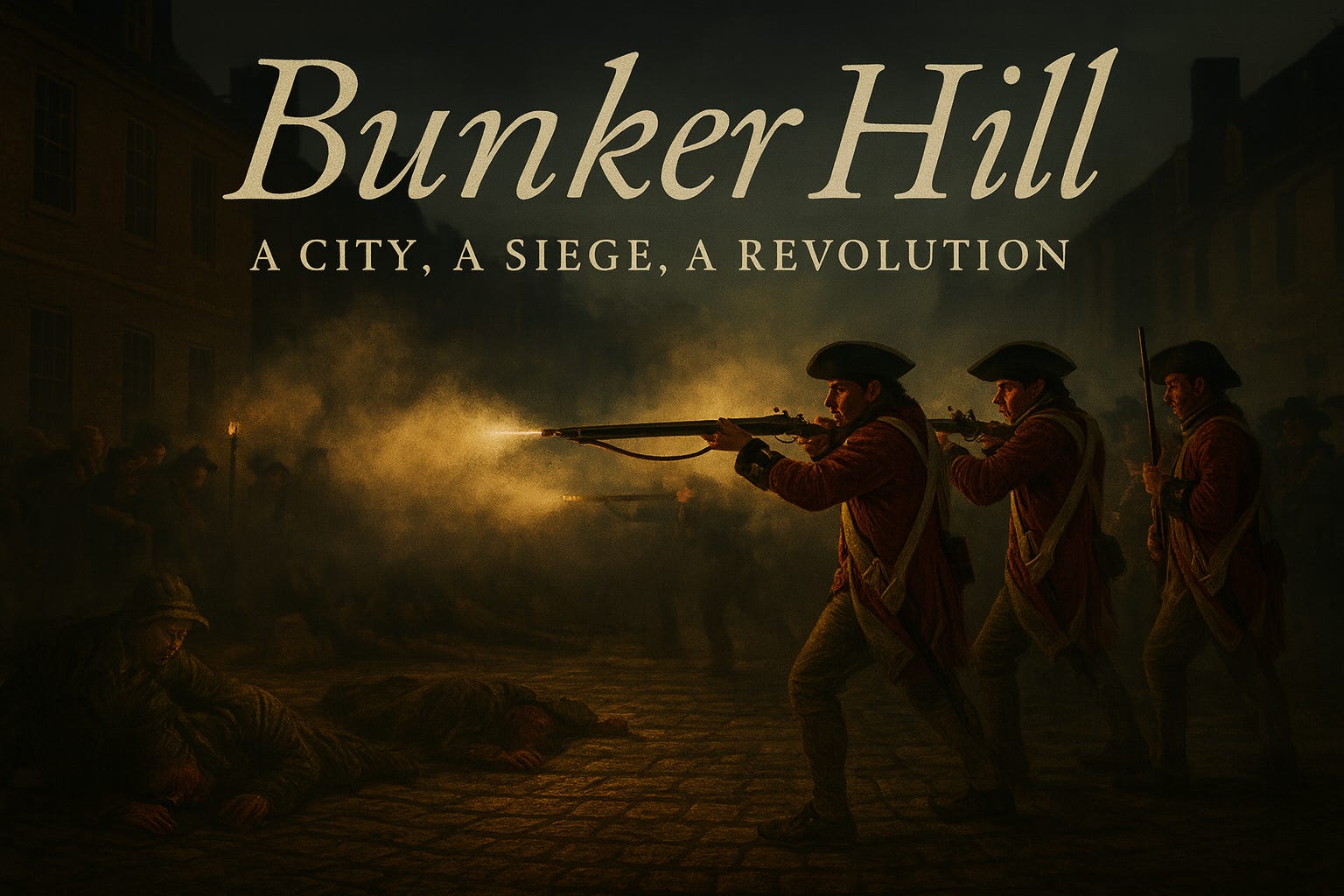
Ground Zero
I recently made my first visit to Boston. I read Bunker Hill in preparation—expecting some background, maybe deeper context on the city's pivotal role in the Revolution. What I got instead was a visceral, layered portrait of a city not just enduring history, but detonating it from the inside out. Walking the Freedom Trail after finishing this book felt like stepping into a live memory: street names snapped into meaning, plaques pulsed with consequence, and I couldn't stop thinking about how much of the real story never made it into textbooks.
Forget what your schoolbooks told you. The American Revolution didn’t begin with clarity or consensus—it began with panic, propaganda, and blood in the streets of Boston.
Nathaniel Philbrick’s Bunker Hill delivers a ground-level view of the messy, uncertain opening chapter of the Revolution. While the title suggests a singular focus, the book includes not just the brutal battle on Breed’s Hill, but the cascading events that surrounded it: the shock and chaos of Lexington and Concord, the grim standoff of the Boston Siege, and the underappreciated engineering marvel that placed artillery atop Dorchester Heights—ultimately forcing the British to abandon the city they once ruled.
Philbrick doesn’t write history to make you feel patriotic. He writes to make you feel present. Through his eyes, Boston in the early 1770s is no longer a symbol—it’s a suffocating, violent, divided town. Streets swarm with gossip and spies. Wealthy Loyalists barricade themselves while Sons of Liberty torch effigies and threaten tar and feather. The air is thick with smoke, sermons, and fear.
What truly elevates this book is its attention to the people history tends to overlook—especially Dr. Joseph Warren, a physician and rising revolutionary whose courage and charisma made him both a leader and a target. Philbrick paints Warren as the on-the-ground architect of rebellion, from rallying minutemen before Lexington to his fateful choice to fight on the front lines at Breed’s Hill, where he was killed in the battle’s final moments—a loss that might have shifted the Revolution’s leadership had he survived. While names like Washington and Revere loom large, Bunker Hill reminds us that revolutions are rarely won by legends alone. They’re built—and bled for—by men history forgets.
This isn’t the America of marble and memory. It’s the America of mobs, misfires, and makeshift militias. And that’s what makes it essential reading.
The Fuse and the Flame
Philbrick doesn’t begin with a bang—he begins with a slow burn.
The early chapters focus on the volatile pressure building in Boston: British troops quartered among increasingly hostile civilians, provocations and propaganda on both sides, and the slow collapse of trust between the colonies and the Crown. He reconstructs the moments before Lexington and Concord with painstaking care—demonstrating how rumor, misjudgment, and reflex can ignite the world. Philbrick’s depiction of the British retreat from Concord, harassed by farmers-turned-insurgents, captures the raw improvisation of those first shots and turns what could have been a routine raid into the Revolution’s chaotic spark.
What follows is a siege, not a sprint. Boston becomes trapped: redcoats penned in by hastily assembled militias, tension simmering on both sides of the city’s edge. Philbrick captures the slow attrition—shortages, politics, and the psychological toll of a war not yet fully declared.
And then comes the heart of the book: the Battle of Bunker Hill.
Philbrick takes his time here, building the pressure wave by wave—how the defenses were constructed overnight, how decision-making faltered among colonial leaders, and how the British marched straight uphill into carnage. His description of the third British assault, with soldiers climbing over their fallen comrades amid withering musket fire, is harrowing and unflinching. The result is one of the most vivid battle narratives in recent memory. No triumphalism. Just dirt, smoke, blood, and consequence. The Americans lose the hill—but win something deeper: legitimacy, resolve, and a sobering awareness of what they’re really up against.
The final act arrives quietly, but powerfully. With the arrival of George Washington and the execution of the Dorchester Heights maneuver—hauling cannons under cover of night—the Revolution gains its first true strategic win. No grand speeches. Just artillery in the darkness and redcoats slipping away at dawn.
By the end, the reader doesn’t just understand the first phase of the war—they feel it. The confusion. The cost. The compromises. Philbrick doesn’t tell us how the Revolution was won. He shows us how close it came to never happening at all.
Last Stand
This review is part of our series marking 250 years since the American founding. While McCullough’s 1776 captures the orchestral sweep of a young nation at war, Bunker Hill digs into the volatile prelude—the year before the Declaration, when rebellion was still a gamble, not a government. If you’ve already read my review of 1776 by David McCullough, you know the contrast: McCullough gives us the orchestral sweep—Washington's desperate gambles, like the daring Delaware crossing, amid the year's broader campaigns. Philbrick brings the street-level smoke and splinters, serving as the raw prelude where figures like Warren set the stage for what followed. Think of it as satellite view versus boots on the ground.
This is not the founding myth carved into granite.
This is the version where the streets smell like sewage and smoke.
Where lines weren’t drawn, they were blurred.
Where liberty was whispered in taverns and bled for in ditches.
Philbrick reminds us that America wasn’t born in a courtroom.
It was born in chaos, fear, rage—and the refusal to be owned.
And if you want to understand the kind of courage it took
to light a fuse without knowing if it would blow your enemies or your future to pieces—
Bunker Hill is the place to start.
Perfect for readers seeking a human-scale history of how revolutions actually begin—imperfectly, violently, and without hindsight. share how these stories reshape your view of the Revolution.
Next up in the series: Revolutionary Summer—a deeper dive into the movement’s turning points.
[FIN/ACK]
Transmission Complete
Process Accordingly
—Protocol One

If this review brought clarity, context, or just a deeper love of history—consider fueling future dispatches.
☕ Support the work: buymeacoffee.com/protocolone
Interested in reading it yourself? You can pick up a copy of Bunker Hill: A City, a Siege, a Revolution by Nathaniel Philbrick on Amazon here. Every purchase made through this link helps support this project—at no additional cost to you.

As an Amazon Associate, I earn from qualifying purchases. This means if you click an affiliate link and make a purchase, I may receive a small commission—at no extra cost to you.